There’s a particular kind of quiet panic that sets in when you walk into your living room and realize the coffee table looks like a lost-and-found bin. My round coffee table was the worst offender, a beautiful light wood piece drowning under remote controls, half-read magazines, and a candle that never got lit.
I knew it had potential. The problem wasn’t the table itself, it was the sheer volume of stuff I was letting sit on it.
So I tore it all off and started from zero. Honestly, it was the best decision I’ve made for our main living space all year. The difference between cluttered chaos and intentional styling is not just about looks, it changes how the entire room feels.
### The Problem with the Before Photo
The “before” look wasn’t just messy; it was visually confusing. We had a dark colored cup on the left, a crumpled receipt, and a stack of books that I never actually read. Nothing matched, and the space had no breathing room.
I remember staring at it and thinking, this table has such a cool shape, but you’d never know it. The split design was completely hidden, and the gorgeous olive green rug underneath might as well not have existed for all the attention it got.
It felt cluttered every single time I walked by. The weird part was, I cleaned it every Sunday, but by Tuesday it was back to being a dumping ground.
I realized the issue wasn’t laziness. It was that I hadn’t given the items on the table a designated purpose or a home.
### Why the Split Design Won Me Over
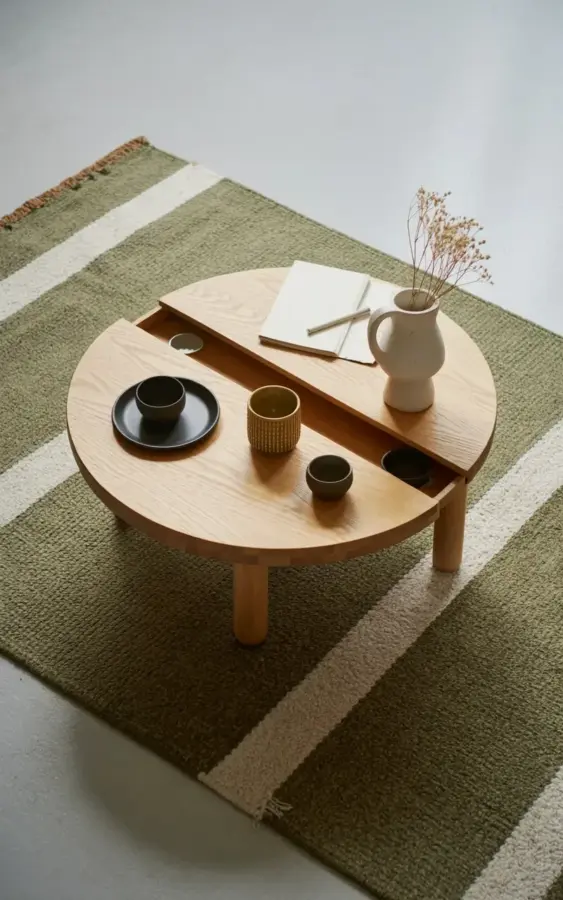
This table has this brilliant, distinctive split design. The closed section is a clever little cubby, and the open section is a wide, shallow tray-like area.
Look, the closed section is a game-changer. I put two darker cups in there, hidden away behind the wood panel. It’s the perfect place to stash extra coasters or anything you don’t want visible but need close by.
The open part is where you get to play. The contrast between the closed storage and the open display creates a clean architectural line. It’s functional, but it also looks intentional, which is half the battle in a minimalist living room makeover.
### Styling the Open Section for a Minimalist Look
For the open section, I kept it to three core elements. A small textured brown ceramic cup, a tiny black bowl, and a white ceramic pitcher holding some dried flowers.
I also added a plain white notebook for a bit of organic height. The setup follows a simple triangle rule, allowing your eye to move across the table without getting stuck anywhere.
Here’s the trick I learned about minimalism: it’s not about having nothing.
– Start with one neutral anchor piece, like that cream ceramic pitcher.
– Add one organic element, the dried flowers work perfectly because they need zero maintenance.
– Finish with a practical item that you actually use, which is the notebook here.
The white and brown tones tie directly into the beige stripes on the olive green rug. Everything belongs together. It feels curated, not staged.
### The Olive Green Rug as the Grounding Element
Let’s talk about that olive green rug. It honestly does all the heavy lifting in this room.
The base is a soft beige, with those vertical stripes of olive adding a strong, earthy punch. When the table was covered in junk, the rug looked muddy and dark. Now, with the light wood tabletop exposed, the rug’s colors pop.
I love how the natural wood legs of the table anchor directly into the pattern. The rug gives the round shape a boundary, so the table doesn’t float awkwardly in the middle of the room.
If you have a dark or busy floor, a rug like this is essential. It defines the seating area and gives the minimal decor a warm foundation to sit on.
### Hiding the Clutter in the Closed Section
Ok so, the split design isn’t just pretty; it’s a hiding spot. I fit two dark colored cups inside that closed section, and they fit perfectly.
This is the detail that makes this table clever. The clean exterior hides the practical interior. If company comes over, the cups stay out of sight, but they aren’t inaccessible.
It’s a small thing, but it reduces visual noise so effectively. You get the look of a pristine surface without having to constantly move things to a drawer.
It reminds me of a kitchen island with hidden appliance storage. Clutter disappears, but the function remains. That’s the definition of good design in a minimalist home.
### What I Learned from This Living Room Makeover
This experience taught me to buy less and style better. I didn’t spend a dime on new decor for this table makeover; I just used what I had and removed the excess.
The dried flowers came from a bouquet I almost threw away weeks ago. The white pitcher was my grandmother’s, and it became the centerpiece of the whole design.
The key (well, one of the keys) is to step back and take a photo. I looked at the first attempt on my phone and immediately saw the issues.
Also, remember to leave empty space on the table. Don’t fill every inch. Let the wood breathe. The table itself is a design element, so let it shine.
### Wrapping Up the Transformation
The whole living room feels calmer now. With the olive green rug anchoring the space and the round coffee table properly styled, the room has an open, airy flow that simply wasn’t there before.
It’s a lot easier to relax when your eye doesn’t have to dodge a pile of junk. I actually use the table more now that it’s not a disaster zone.
If your coffee table is stressing you out, honestly, just strip it back to zero. Start with one or two meaningful pieces, and don’t be afraid to hide the rest.
Then take a photo. You’ll love what you see.
Leave a Comment