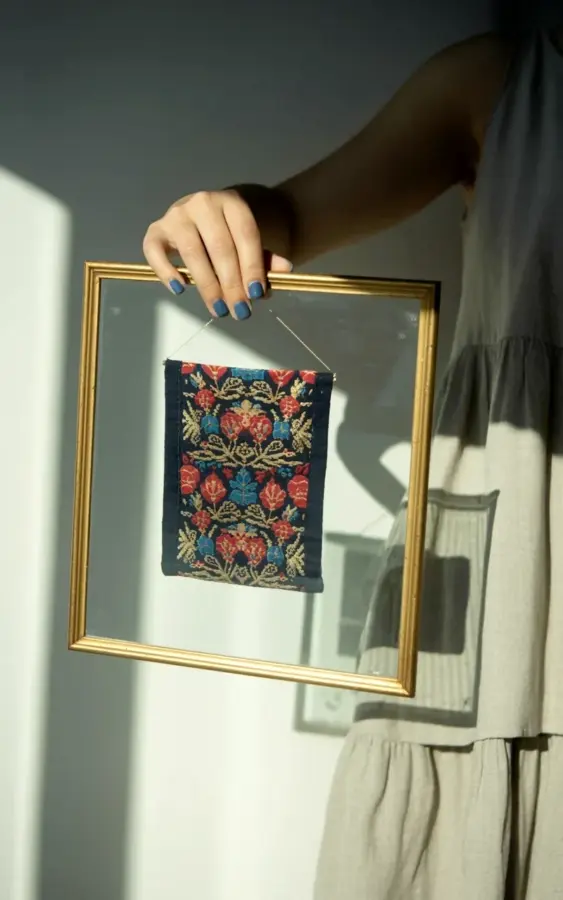
One hand with blue nail polish, holding a gold frame against a white wall. That was the photo that stopped my scroll. The frame itself was nice, sure, but the textile inside, that deep navy fabric with the red and gold flowers, was the real star. I have framed my fair share of vintage fabric, and honestly, I have ruined a few pieces along the way. This gold frame display idea for a textile wall hanging is exactly the kind of project that looks simple but has a dozen small traps hiding in the details. Let me walk you through the biggest mistakes I have made so you do not have to repeat them.
The first thing people assume about framed textile art is that any old frame will do. That is wrong. A heavy tapestry needs a deep frame, not a flimsy one from a discount store. The glass needs to sit far enough away from the fabric that the weave never touches the surface. Moisture gets trapped when fabric presses against glass, and that leads to mold spots you cannot unsee. Look for a shadow box frame with at least a half inch of depth. Your grandmother’s embroidery deserves better than a warped poster frame.
## Why a Standard Picture Frame Ruins Delicate Fabric
You know that sinking feeling when you open a box and the glass is cracked? That is nothing compared to the disappointment of opening a frame and finding your antique linen stuck to the glass with mildew. Standard picture frames are built for flat paper, not puffy textiles. The frame depth is too shallow, and the backing board is often acidic cardboard that leaches yellow stains into your fabric over time.
Here is the thing about natural fibers, they breathe and shift with humidity. Cotton and linen expand and contract. When you squeeze them into a tight frame with no room to move, they buckle and crease permanently. I learned this the hard way with a piece of jute fabric that had the most beautiful geometric pattern. The jute was stiff, so I forced it into a shallow frame. Within three months, the corners had folded over and left permanent white stress marks. Jute decor is trendy right now, but it is also unforgiving if you treat it like paper.
## The Safety Pin Disaster and Other Mounting Fails
Please do not use safety pins to hold your fabric in place. I did that once, and the rust bled through the fabric within a week. That brass-toned pin looked fine on day one, then it left an orange stain on a piece of vintage fabric display that I had paid way too much for. There are better ways to mount a textile.
– Use archival acid-free mounting tape on the back edges only, never on the front of the fabric.
– Stitch the fabric to a piece of acid-free felt or muslin using a curved needle, this distributes the weight evenly.
– For heavier tapestries, sew a sleeve onto the back and slide a wooden dowel through it, then attach the dowel to the frame backing.
– Never use staple guns. Just don’t. The staples puncture the weave and create weak points that tear over time.
The stitching method sounds intimidating, but it takes ten minutes and saves you from so much regret. And do you want to know a secret? Use cotton gloves when handling the fabric. The oils from your fingers attract dust and can stain delicate textiles. I learned that one from a museum conservator, and it is the difference between a piece that lasts decades and one that looks dingy in a year.
## Matching the Frame to the Fabric Without Clashing
That photo with the gold frame and the red, blue, and gold flowers worked because the metals echoed each other. The gold in the frame pulled out the gold threads in the embroidery. If the fabric had been all cool blues and greys, a warm gold frame would have fought with it. The frame should be a supporting character, not the main event.
For a floral tapestry with dark navy tones, go with a brushed gold or brass frame. For muted earth tones and jute decor, try a natural wood frame or a matte black one. Do not overthink it. Hold the frame up against the fabric and see if your eye moves to the textile or to the frame. If you are looking at the frame first, it is wrong. That simple test has never failed me.
And the mat, if you are using one, keep it simple. A wide white or cream mat can give your vintage fabric display some breathing room. But skip the patterned mats and the neon colors. The fabric is the art. The mat is just the hallway leading to it.
## The Lighting Problem Nobody Talks About
The photo I mentioned earlier had nice lighting, soft, even light from a window. But direct sunlight is the enemy of everything you love. Ultraviolet rays fade natural dyes faster than you would believe. I had a beautiful red and gold embroidered piece that faced a west-facing window, and within one summer, the red had turned a washed-out coral. The gold threads were fine, but the damage was done.
Use UV-protective glass in your frame. It costs a bit more, but it is worth every penny. And do not hang framed textile art where the sun hits it directly for more than an hour a day. A hallway with indirect light is perfect. A spot above a radiator is not, the heat dries out the fibers and makes them brittle.
Also, consider what is behind the frame. A spot on an exterior wall can have condensation issues. Give the frame a little space from the wall, or use a cork backing layer to absorb moisture. Your fabric will thank you.
## Measuring Twice and Cutting Once, the Frame Size Trap
You cannot just guess the dimensions of your fabric and buy a frame that is close enough. I did that with a jute wall hanging, and I had to fold the edges under, which made the whole piece look lumpy and amateur. Measure the fabric while it is lying completely flat. Do not stretch it, do not pull it, just let it lie naturally, because that is how it will sit in the frame.
Add about a quarter inch of breathing room on each side. If your fabric has a fringe, you need to account for that too, tucking the fringe flat is nearly impossible without squashing it. Sometimes it is better to let the fringe extend beyond the mat opening, or even remove the mat entirely and let the fabric fill the whole frame. With fringe, I almost always skip the mat and put the fabric right against the backing board.
## Where to Hang Framed Textile Art in a Natural Decor Room
Natural decor is all about texture and warmth. A framed textile piece fits into a room with linen curtains, jute rugs, and wooden furniture like it was always meant to be there. In that photo, the person was wearing a light gray linen dress, and the arm cast a soft shadow on the white wall behind the frame. That whole scene felt calm and organic, nothing shiny or manufactured.
Hang your framed textile art at eye level, around 57 to 60 inches from the floor to the center of the piece. In a dining room, you can hang it lower. In a hallway, slightly higher. The frame should relate to the furniture below it, so if you are hanging it above a console table, leave about 6 to 8 inches between the tabletop and the bottom of the frame. And if you are grouping it with other wall decor, keep the gaps between frames consistently at 2 to 3 inches. Cluttered walls undermine the simplicity of natural decor.
The shadow on the wall in the photo reminded me of something else, the frame will cast shadows depending on the lighting. That can be a good thing, it adds depth. But if the shadow makes the glass glare, you have a problem. Use adjustable picture lights to control the lighting direction, or just watch how the light moves through the room during the day before you commit to a spot.
## Protecting Your Vintage Fabric Display From Dust and Time
Glass is not just for keeping the fabric safe from little hands and curious pets. It keeps dust off the surface, which is a huge relief when you have a delicate tapestry with intricate folds where dust loves to hide. But the glass itself will get dusty, and cleaning it is a chore in itself. Never spray glass cleaner directly onto the glass when it is in the frame. The liquid can seep down the edges and stain the fabric. Spray the cleaner onto a microfiber cloth instead, then wipe the glass. It takes an extra ten seconds and saves you from a disaster.
Check the back of your frame every year. Open it up, look for signs of moisture or insects, and make sure the fabric has not shifted. Once a year is enough. You want to enjoy the piece, not baby it constantly. But a quick check beats a horrific surprise later.
The best part about framing a textile instead of leaving it loose is the permanence. A framed fabric no longer needs to be taken down and shaken clean, it does not need to be protected from accidental snags. It becomes a proper piece of art, like a painting, but with more soul. When you do it right, with UV glass and acid-free materials and a gold frame that actually flatters the colors, it looks intentional. It looks like you planned every detail, even if you were improvising the whole time.
That scrap of vintage fabric sitting in your closet, the one with the slightly frayed edge and the colors that remind you of someone’s farmhouse kitchen, it deserves better than a drawer. Put it in a gold frame and let it face the world. If I can do it without wrecking the fabric, you absolutely can too. Just avoid my early mistakes, skip the safety pins, measure properly, and find a frame with enough depth. Then stand back and admire your work. What are you waiting for, go rescue that fabric from the bin and give it the display it has been missing.
Leave a Comment