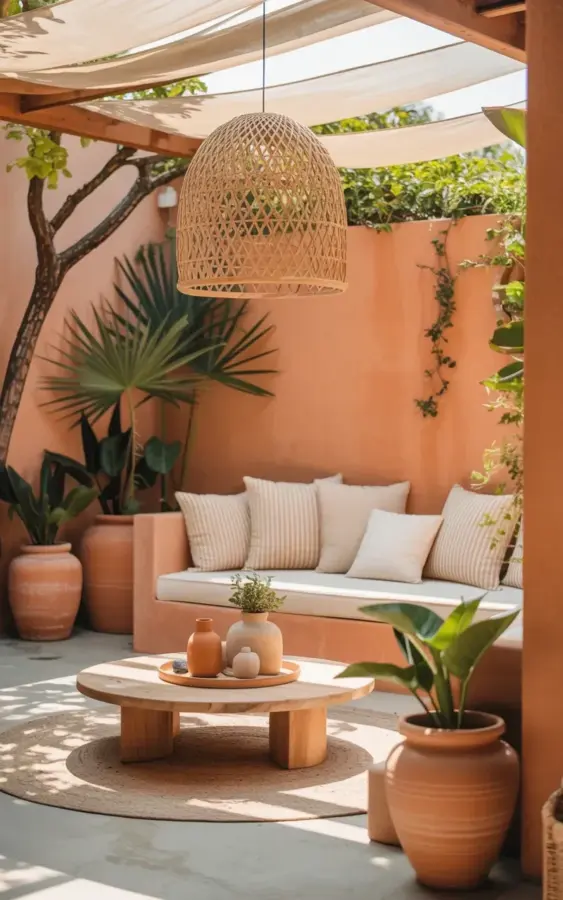
The scroll just landed on the exact patio setup you’ve been saving for months, and now you’re staring at your own empty slab of concrete wondering where it all went wrong. That terracotta wall and rattan pendant light combination has become the unofficial uniform for tropical patio ideas everywhere, but honestly, most DIY attempts at recreating it fall flat. The good news is the original design is actually pretty forgiving. The bad news is people usually mess it up by buying cheap matching sets and calling it a day.
This particular outdoor patio idea works because every piece looks like it was found over time, not ordered from a single catalog in a panic. The terracotta walls glow with that sunbaked warmth you can’t fake, and the rattan pendant light breaks up the harsh ceiling line while throwing soft shadows everywhere. It feels collected, lived-in, and completely unstoppable. So instead of giving you another generic checklist, let’s walk through the common mistakes that kill this vibe and how to sidestep each one before you waste money on stuff you’ll regret by August.
## The Mistake of Prioritizing Looks Over Climate
Here’s the thing everyone forgets when they fall in love with a photo like this. That rattan pendant light is gorgeous, but it will absolutely disintegrate if you live somewhere with freezing winters or a monsoon season that lasts four months. Natural woven materials need shelter or serious weatherproofing, and most cheap indoor versions won’t survive a single humid summer night outside.
Check the IP rating on any lighting fixture before you get attached to it. Look for at least IP44 for covered patios, and if your space is fully exposed, you need something rated for direct rain exposure. The photo shows this light hanging under a solid ceiling, which gives it partial protection. If your patio doesn’t have that overhead coverage, you might need to use a synthetic rattan lookalike that mimics the texture without rotting the moment a storm rolls through.
## Setting Up the Wrong Seating Direction
The curved white bench in this setup isn’t just pretty, it’s doing the heavy lifting for the entire layout. A curved piece forces the eye to move around the space instead of just bouncing off a straight wall. Most people buy a standard rectangular sofa because it fits against a wall easily, and then they wonder why the space feels like a waiting room.
Take a hard look at the actual footprint of your patio before you commit to any furniture shape. If you have a long narrow space, a curved bench hugging the back wall opens up the center for movement. If you’re working with a square patio, angle your seating instead of shoving everything against the perimeter. The human eye naturally follows curves, which is why this arrangement feels so inviting rather than just being a row of chairs staring at a wall.
## Ignoring the Power of Uneven Planter Heights
Look at the clay planters in the reference photo. None of them match, and that’s exactly the point. They range from low wide bowls to tall statement vessels, with palms and climbing vines spilling over the edges at completely different levels. This creates that jungle vibe without actually requiring you to own fifty plants.
The mistake amateur decorators make is buying planters in a matching set of three identical sizes. Uniformity kills the tropical feeling because it reads as deliberate retail display, not organic growth. Mix heights aggressively. Put a tall palm in a narrow terracotta urn next to a squat pot with trailing ivy, and let them crowd each other a little. Plants like being packed in, and your patio will instantly look like it’s been growing for years instead of styled this morning.
## Using Throw Pillows as an Afterthought
Striped beige and white throws on that curved bench look effortless, but there’s a reason they work and it’s not just the color palette. Those pillows are providing necessary contrast against the white cushion. If I had a dollar for every outdoor patio I’ve seen ruined by a set of matching solid-color pillows that repeat the cushion color exactly, I could buy a whole new rattan ceiling light.
Do not buy the four-piece pillow set that comes bundled with your bench. It’s always too matchy and they’re always the wrong size. Go for varied sizes instead, maybe two large rectangle pillows and one smaller square, and don’t be afraid to mix a subtle pattern with a solid texture. Stripes work here because they echo the horizontal lines of the terracotta wall tiles without competing with the plant shapes.
## Hanging the Pendant Light at the Wrong Height
Ok so this one genuinely makes me irrationally angry because it’s such an easy fix. The rattan pendant light in this photo hangs low enough to create an intimate glow but high enough that you never hit your head when you stand up from the bench. People either hang these things too high, where they lose all their impact and just become a distant ceiling ornament, or too low, where every guest instinctively ducks when they cross the room.
The general rule for a dining height is 30 to 36 inches above the table surface. But this isn’t a dining table, it’s a conversation area. You want the bottom of the light fixture to sit somewhere between 7 and 8 feet above the floor, depending on the ceiling height. Stand in the actual space and do a little test wave with your arms above your head. If you can comfortably stretch without touching it, you’re probably in the right zone.
## Letting the Coffee Table Become an Afterthought
The round wooden coffee table with that natural finish in the center of the photo is doing three jobs at once. It’s giving people a place to rest drinks, it’s anchoring the entire seating arrangement, and it’s softening the hard angles of the tile and wall. People trying to recreate this patio idea often swap in a metal table because it feels more outdoor-durable, and the result ends up looking cold and industrial.
Wood is completely fine outdoors if you seal it properly. Teak is a classic choice for a reason, it handles moisture and sun without turning into a warped mess, but you can also use acacia or even a treated pine if you’re on a budget. The key (honestly, the real key) is that the wood tone should be lighter than the terracotta walls so it stands out instead of blending into a muddy brown blob.
To get this part right, keep these details in mind:
– Choose a round table over a square one to keep traffic flowing smoothly
– Leave at least 18 inches between the edge of the table and the bench cushions
– Use a tray or a shallow bowl to corral small items so the surface doesn’t turn into clutter central
– Consider a table with a lower shelf for extra storage, it’s a lifesaver when guests show up unannounced
## Skipping the Layer Between Seating and Floor
When people recreate this patio idea, they forget that the curved white bench alone creates a weird gap between the seating area and the actual ground. You need something soft underfoot, and I’m not talking about an expensive outdoor rug you’ll spend the entire season worrying about. A natural jute or sisal rug in a light neutral tone breaks up the terracotta tile and grounds the whole seating group.
Pick a rug that’s large enough to fit the front legs of the bench and the coffee table comfortably. An outdoor rug that’s too small makes the space look disconnected, like the furniture just floated into random positions. And watch out for rugs with heavy patterns here. Since the walls already make a strong color statement, you want the floor covering to stay quiet. Let the plants and the pillows do the loud talking.
## Forgetting the Light Source Needs a Warm Bulb
This photo has that specific glow that makes you want to cancel your dinner plans and just sit right there. The rattan pendant light is part of it, sure, but honestly, the bulb choice is doing at least half of the work. If you screw in a cool white LED, that beautiful handwoven texture instantly looks like cheap plastic and the terracotta walls take on a weird sterile gray tone.
Buy bulbs with a color temperature of 2700K or lower. That’s the warm, slightly golden light that mimics candlelight and makes everyone’s skin look great. Also consider adding a dimmer switch so you can dial it down as the evening progresses. Guests don’t want to feel like they’re sitting in a surgical suite, they want to feel like they’re on a slow tropical evening where nothing needs to be urgent.
The whole point of this patio design isn’t the individual pieces, it’s how they work together to create a moment of stillness. Terracotta walls hold the heat of the day and release it slowly at night. Rattan adds texture and a handcrafted feel that metal and plastic just can’t match. Plants bring life in the most literal sense. When you strip it all down, this is a space built for one activity, sitting down and exhaling for the first time in hours.
Try one of these fixes at a time if you need to. Swap the lightbulb this weekend, adjust the planter heights next month, and gradually you’ll get there without burning out or breaking the bank. Your patio won’t look like a magazine cover overnight, but it will start feeling like someone with good taste actually lives here. Start with the light bulb, honestly, it’s the cheapest change you can make and you’ll see a difference the second you flip the switch.
Leave a Comment