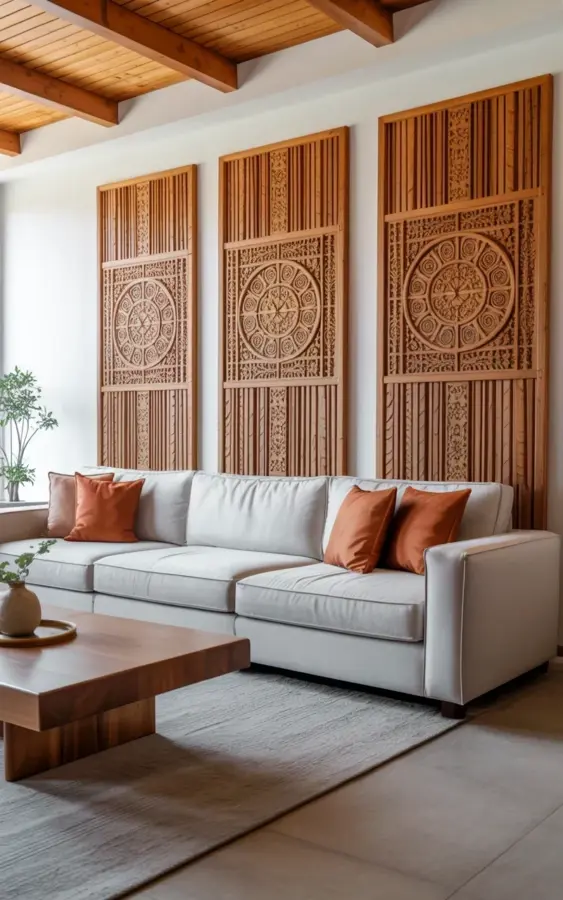
Take that living room you have been scrolling past for weeks, the one with the carved wood panels and the perfect gray sofa, and ask yourself what is actually missing. It is not a new throw blanket and it is definitely not another plant. It is the floor. Jute rug ideas for a natural living room usually come down to this one moment where you realize the whole space needs something soft to land on, something that feels like it has been there forever. The photo that started this whole thought process shows a beautiful space with three large carved wooden wall panels, exposed ceiling beams, and a light gray sectional propped up with terracotta pillows.
A jute rug brings exactly that grounded, quiet texture to a room that already has a lot of visual interest. Unlike a plush wool carpet that demands attention, jute sits back and lets the wood wall decor do the talking while still making the whole space feel warmer. It is the kind of addition that does not scream, it just settles the room down.
Why Jute Works With Carved Wood Wall Panels
Wood has a lot of presence, especially when it is mounted on a white wall in large carved panels with those deep circular patterns and vertical striations. Your eye follows all that texture, but if the floor is bare or covered in something flat, the room can feel top-heavy, like all the energy is stuck up high near the ceiling.
Jute changes that completely. The coarse, woven fibers carry the same earthy warmth as the wood panels but in a softer, lighter way. It is like the floor is echoing the walls, not copying them. The natural tan and straw tones of a jute rug blend with almost any wood finish, which honestly makes it the easiest design decision you will make.
Here is the thing about texture mixing. You do not want everything to match perfectly. The striated wood panels have a rhythm to them, a repeating vertical line that feels formal. Jute breaks that up with its messy, organic weave. It introduces a little imperfection, which is exactly what makes a room feel lived-in instead of staged.
Pairing Jute With a Gray Sectional and Terracotta Pillows
If your sofa is light gray, any floor covering you choose has to walk a fine line. Too dark and the space feels heavy, too sleek and the couch starts to look like office furniture. A jute rug keeps that gray sectional feeling soft and approachable without competing with it.
Now the terracotta pillows, those are where the room gets its personality. The rust and clay tones pop against gray, but they also share that earthy parentage with jute. Terracotta is baked earth, jute is woven plant fiber, they are siblings in a way that is hard to fake with other materials. Together, they create that calm, handcrafted atmosphere that everyone seems to be chasing lately.
How Jute Complements a Natural Wood Coffee Table
That large wooden coffee table with the natural finish in the photo is another clue. You have got wood on the walls, wood overhead on those exposed beams, and a wood table in the center of the room. Add a jute rug under all of it and suddenly the wood pieces stop being separate objects and start being part of one cohesive natural living room.
Jute actually softens the transition between the hard surfaces and the soft seating. It acts like a neutral bridge. And because jute is relatively flat, it will not interfere with pulling the coffee table closer to the sofa or moving chairs around when you have guests over.
Choosing the Right Jute Rug Size for a Living Room
Get this wrong and it will drive you crazy every single time you walk into the room. Measure your seating area, not your entire room. The rug should extend at least 12 to 18 inches past the front edge of your sofa on the sides, but here is a little secret, it does not need to go under the whole couch.
The front two legs of the sectional should sit comfortably on the rug. The back legs can stay off. This keeps the space feeling connected while still showing off some of the floor. For a room with heavy elements like large wood wall panels, you actually want to see a bit of bare floor around the edges. It prevents that over-stuffed feeling.
A rug that is too small is the most common mistake. You have seen it, the little island of a rug floating in the middle of the room with furniture half on and half off, looking like it is not sure where to commit. Do not do that. Go bigger than you think you need. Jute is usually pretty affordable compared to wool, so you can size up without wrecking your budget.
Layering a Cowhide or Faux Sheepskin on Top
This is a styling trick that works stupidly well with jute. Because jute has that tight, flat weave, it is a perfect base layer for a softer rug on top. You can take a small cowhide or a chunky faux sheepskin and toss it near the center of the seating area, right at the coffee table edge.
The contrast between the rough jute and the plush furry texture is genuinely interesting. It adds visual depth, and honestly, it feels amazing if you walk around barefoot. It also gives you a way to personalize your jute rug ideas without committing to a different foundation rug. You can swap the topper seasonally, which is a nice little reset when the mood strikes. Plus, it protects the jute in the highest traffic zone, which is always a good idea. Jute can be a bit rough if you are used to soft carpet, so a layered top layer gives you that soft spot right where you step.
Caring for Jute in a Real Living Room, Not a Showroom
Here is where I have to be straight with you. Jute is not as forgiving as synthetic rugs. It is a natural fiber, which is part of its charm, but it does not love moisture. Spills can stain quickly if you do not blot them right away, and direct sunlight can fade the natural straw color over time.
That being said, for a living room where people sit (and sometimes eat) but where you are not sprinting through with muddy boots, jute holds up fine. Vacuum it weekly without the beater bar, because the aggressive brush can break the fibers. Flip the rug every few months so it wears evenly. If you spill something, blot it with a dry cloth and do not rub. A little water with mild dish soap works for most accidents, but honestly, just get to it fast and you will be okay.
Place a rug pad underneath. This is non-negotiable. Jute rugs are not very thick, so a good pad extends their life and keeps the edges from curling up. It also stops the rug from sliding on hard floors, which would be a real hazard with a heavy wood coffee table sitting in the middle.
The Overall Cozy Vibe You Are Actually Going For
Look, at the end of the day, you are building a room that you actually want to sit in. The natural living room with wooden wall panels and terracotta throw pillows is already a strong look. What jute does is pull everything down to the ground and wrap it in a quiet sort of calm.
Which part of this setup feels coziest to you? For some people it is the wood texture, for others it is those terracotta pillows. I will say this, the room in that picture is missing the final layer. A jute rug underfoot is that layer. It completes the space without trying to steal the show. It is the kind of detail guests might not consciously notice, but they will feel it when they take their shoes off and stand on something warm and natural instead of cold tiles. And that, honestly, is the whole point of cozy. So if you are thinking about adding one to your space, stop overthinking the rest. Start with the rug, then let the room figure itself out from there.
Leave a Comment