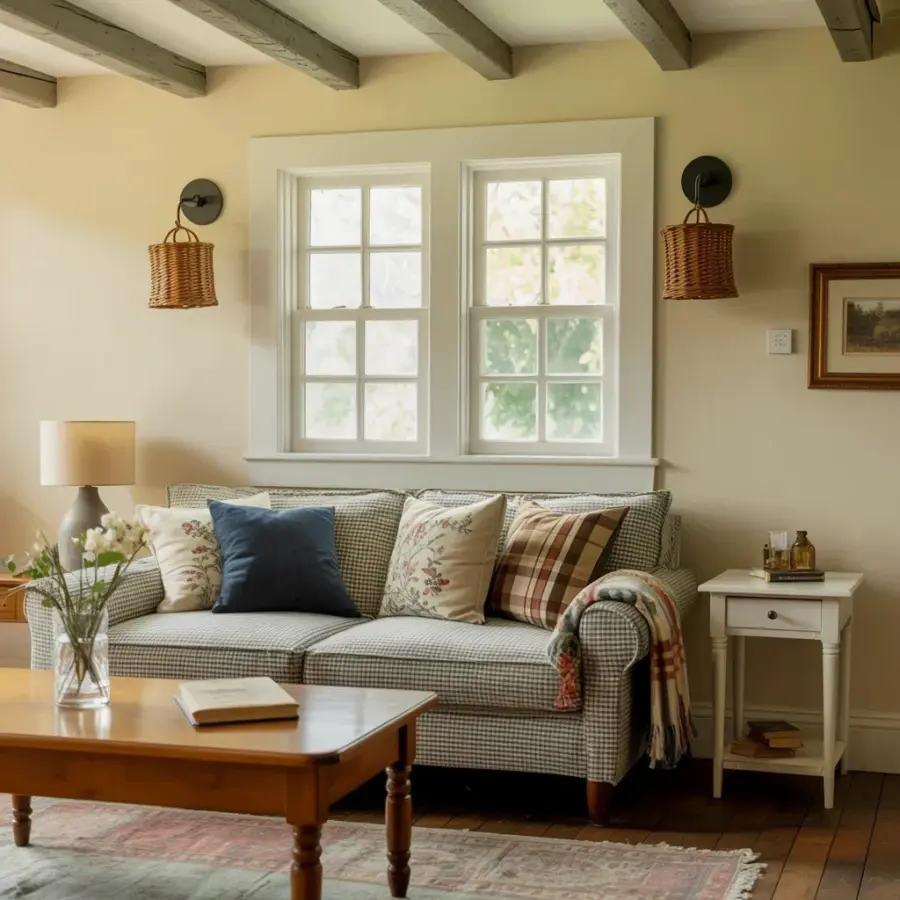
There is a corner of my brain that relaxes the second I see white bedding against a light wood floor. It happened again last week, while I was scrolling through Pinterest and landed on this coastal cottage bedroom with a wicker tray sitting right in the middle of the bed. That tray, with a small jar of dried lavender and an old paperback on it, did more for the room than any expensive piece of furniture. And honestly? It made me want to recreate the whole look in my own rental apartment. You can do it too, even if you’ve never styled a bedroom in your life.
Why a coastal cottage bedroom starts with a calm color palette
Before you buy a single decor piece, look at your walls. Coastal cottage style is built on quiet colors, not loud ones. Think warm sand, pale driftwood gray, soft sea foam green, or just plain white with a slight warmth to it. These colors do something important. They make the room feel like it has been there forever, like the ocean air naturally faded everything into agreement.
If you can’t paint your walls, don’t panic. I’ve lived in apartments where the walls were an unfortunate beige, and a big sandy-colored rug on the floor fixed most of the problem. Linen curtains in a natural oatmeal tone help too. They soften the light and make the room feel a little more cottage-like. The goal is a background that doesn’t fight for attention, because the bedding and the accessories are the real stars.
The crisp white bedding formula that always works
White bedding is the non-negotiable layer in this look. Not bright white, not blue-white. A soft, warm white, like the inside of a seashell. The trick is to mix textures so the bed doesn’t look like a hotel room or, worse, a hospital room. Use a relaxed linen duvet cover as the main layer, then add a cotton quilt folded at the foot of the bed. That combination reads as both lived-in and intentional.
- Start with a white fitted sheet and a pair of breathable white pillowcases.
- Add a linen duvet cover in a slightly textured white or off-white.
- Fold a quilt or matelassé throw at the bottom, this gives the bed weight and keeps it from looking floaty.
- Finish with two Euro pillows or a woven lumbar pillow for a tiny bit of contrast.
Here’s something I learned the hard way: don’t buy cheap white sheets. They turn gray after a few washes, and then you’ll be annoyed every time you make the bed. Save up for a mid-range set in a natural material like cotton or linen. You’ll feel the difference immediately.
What to look for in a wicker tray (and how to style it)
Ok so, the wicker tray. It might seem like a small thing, but it’s the piece that makes the whole bed feel styled rather than just made. A tray gives your eyes a place to rest and a reason to not toss your phone and glasses directly onto the sheet. I have a wicker tray that I bought for two dollars at a church rummage sale, and it still has the faint smell of someone’s attic, which I’ve decided is actually a feature. It has a small crack in one corner, and I hope it lives forever.
When you’re picking your own tray, look for one that has a flat, sturdy base. It doesn’t have to be huge. A tray that’s too big can overwhelm the bed, especially if you only have a full or queen size. A small rectangular tray works best. Position it slightly off center, not dead in the middle, so the bed feels effortless. Then put just two or three things on it. A small vase with dried grass, a candle in a glass jar, a single book with an aged cover. Resist the urge to fill it up. The empty space is part of the appeal.
Making a beach print gallery wall that feels collected, not copied
The gallery wall in this coastal cottage bedroom is what gives the space its personality. It’s not a giant canvas of a dolphin leaping out of the sea, thank goodness. It’s a mix of smaller framed prints, like vintage botanical beach grasses, faded nautical maps, and simple watercolor seascapes. If you’re new to this, start with an uneven number of frames. Three is easy. Five is better. That makes the arrangement feel relaxed instead of overly symmetrical.
You don’t need to buy matching frames. Actually, mismatched frames in similar tones work better. Try using all wood frames, but mix the shades. A dark walnut frame next to a light oak frame looks intentional if you keep the matting white or cream. Before you hammer any nails, lay the frames on the floor and play around with the arrangement. Take a photo with your phone and flip through the options. That will save you from a wall full of crooked holes.
Nautical charm without the clichés
Nautical charm is a tricky thing. One wrong anchor or overly glossy ship wheel and you’re suddenly in a themed restaurant. The trick is to use materials that whisper the ocean instead of shouting it. A piece of weathered rope coiled in a shallow bowl. A small glass bottle filled with fine sand. A driftwood branch propped in a vase. Those objects carry the coastal story without hitting you over the head.
For the cottagecore version of this style, think of it as a love letter to the shore, not a museum of marine artifacts. A stack of old hardcover books in faded blue and green tones on the nightstand says as much about the beach as any shell does. One washed-out watercolor of a lone sailboat can do more than a whole basket of starfish. Start with one nautical item and see how it feels. You can always add more, but you can’t un-add something without noticing you’ve gone too far.
Pulling the beach house bedroom look together
By now you have the walls sorted, the crisp white bedding in place, the wicker tray styled, and a gallery wall that actually fits your space. The last step is to consider the floor and the windows. A flat-weave jute rug adds warmth and texture, and it’s a classic beach house choice because it hides sand beautifully. For the windows, skip heavy drapes. Instead, use simple white linen panels that let in light while still giving you privacy.
If you want a quick checklist, here’s the whole process in one sentence. Paint the walls a warm neutral, put white textured bedding on the bed, set a small wicker tray off to one side, hang a few mismatched beach prints, and let natural materials handle the rest. It really is that simple. The best rooms are the ones where you can’t tell where the effort ended and the living began.
And keep in mind that you’re allowed to change things. Maybe the tray needs a different candle next month. Maybe you find a better print at a flea market and swap it with the one above the nightstand. That’s the fun of decorating this way. It’s not about perfection. It’s about making a room that feels like a deep exhale.
If you’re ready to try this in your own bedroom, start with the wicker tray. It’s the least expensive piece, and it’s the one that makes people stop and say, “Oh, I love that.” Walk through your house and look for a tray or a shallow basket that you no longer use. Put it on your bed with one or two small things and see how it changes the whole mood. Send me a picture if you do. I’d love to see which colors and textures you chose.
Leave a Comment