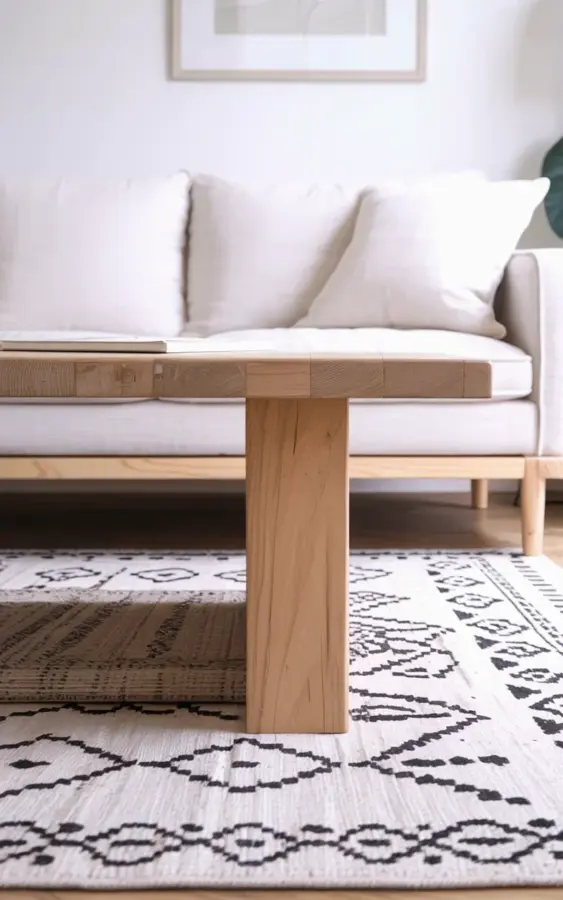
There’s a quiet confidence in a room where a black and white Moroccan rug sits beneath a chunky wood coffee table, and honestly, that confidence is harder to pull off than it looks. The photo that started this whole post shows exactly what I mean: a light wooden table with a thick, plank-style top and one solid leg, resting on a geometric tribal rug with diamond shapes and abstract motifs. Behind it, a white upholstered sofa with clean lines and light wooden legs keeps the whole scene calm. It looks effortless. But most people try to recreate this vibe and end up with a living room that feels like a cluttered market stall or, worse, a showroom that nobody actually lives in. This guide is about the common mistakes, the missteps I see all the time, and how to avoid them when you’re styling your own space with a Moroccan rug and a wood coffee table.
Mistake #1: Letting the Rug Disappear Under the Furniture
The biggest error I see is people buying a Moroccan rug that’s too small for the room, then pushing it entirely under the sofa so only a tiny strip peeks out. You’re not doing yourself any favors here. The rug’s geometric pattern, those black diamonds and abstract tribal lines, is a major part of your minimalist living room decor. It needs room to breathe.
Your front legs of the sofa should rest on the rug, and you need at least a few inches of visible rug on all sides, especially in the center of the room. In the photo context, you can see the rug extends well past the coffee table, giving the whole setup a solid foundation. If the rug is too small, the entire space feels off balance.
Here’s the thing about a Moroccan rug: it’s meant to define a zone, not just protect the floor. Give it space to do its job.
- Make sure the rug extends at least 12 inches past the sides of your coffee table.
- Both front legs of your sofa should sit comfortably on the rug.
- Keep the rug’s pattern visible outside the outer edge of the table, don’t completely cover it.
Mistake #2: Choosing the Wrong Wood Coffee Table Finish
Ok so let’s talk about the coffee table itself. A Moroccan rug has a lot of visual texture and pattern, even if the colors are just black and white. So the table you put on top of it matters more than you think. A glossy, dark espresso table might look chic in a catalog, but in a minimalist boho living room, it often creates a heavy, oppressive block in the center of the space.
You want a wood coffee table with a lighter, natural finish. The light wooden table in the reference photo is perfect because it contrasts with the dark rug pattern without fighting for attention. Honestly, I’m a sucker for a thick, chunky wood plank top. It brings that organic, natural texture that boho decor craves. A solid wooden leg, not four skinny ones, grounds the table and gives it a sculptural feel.
Matching the wood tones to your sofa legs is a subtle trick that makes everything look intentional. In the photo, the table and the sofa share that pale wood tone, which ties the whole look together far more effectively than any throw pillow could.
Mistake #3: Ignoring the Scale of the Room and the Rug Pattern
Let me complain about something for a second: scale. I can’t tell you how many times I’ve seen a massive, bold Moroccan rug in a tiny apartment, swallowing the living room whole. But the opposite is also true. A small, delicate rug under a huge sectional looks like a postage stamp. The size of the pattern matters too. The bold diamond pattern on the rug in the photo works because the furniture around it is simple and unobtrusive. You need to consider the layout of your whole room, not just the rug and the coffee table.
Before you buy anything, measure your seating area. Leave about 18 inches between the edge of the rug and the wall to create a nice border of floor. This creates that curated, gallery-like feel that minimalist living rooms are known for. The pattern of the rug should also be proportional to the size of your table. A huge, sprawling pattern under a tiny side table looks chaotic, but the same pattern under a wide, substantial coffee table looks grounded and perfect.
Mistake #4: Overloading the Coffee Table Surface
This is the mistake I have to stop myself from making every single weekend. You find a cool Moroccan rug, you get the perfect chunky wood table, and then what happens? You pile it with books, candles, coasters, a plant, a remote holder, a decorative bowl, and a framed photo. Suddenly, you can’t see the beautiful tabletop anymore.
Look, let the rug’s pattern do the talking. That’s the entire philosophy of this minimal setup. The coffee table styling should be restrained. On a table like the one in the photo, with its thick, textured surface, you only need one or two objects. A sculptural ceramic vase with a few dried grasses, or a small stack of your favorite books.
You don’t need to fill every square inch. The negative space is what makes the wood grain and the rug pattern stand out. If you have a wooden tray, use it to corral your remotes and coasters into one small corner, and leave the rest of the surface completely bare. It feels weirdly liberating, not gonna lie.
Mistake #5: Forgetting the Texture Around the Rug
A Moroccan rug is tactile, even if you’re just looking at it. The weave, the wool, the slight unevenness of the tribal pattern, it all screams “touch me.” If the rest of your room is hard and cold, with metal legs and polished stone, the rug will feel out of place. Your boho decor needs layers of texture to really work.
That white upholstered sofa in the photo is the perfect companion to the rug. The smooth, matte fabric contrasts with the rug’s wool while still staying in the same tonal family. If you have a leather sofa, that can work too, but be prepared for a very different, more rugged vibe. I’d also argue you need a soft throw blanket draped over the arm of the sofa. Not for warmth, but for that casual, lived-in look that makes a minimalist boho living room feel inviting.
And don’t forget the walls behind the setup. A plain white wall is good, but a subtle texture like limewash or even a simple wood slat feature wall behind the sofa can add another layer of depth without introducing clutter. It’s all about building a composition that feels natural and layered, not just flat and decorated.
Mistake #6: Treating Boho Decor Like a Checklist
There’s a common misconception that boho decor requires macrame wall hangings, a fiddle leaf fig, a mountain of pillows, and a pouf in the corner. That’s a Pinterest board, not a home. Real boho spirit is about curated imperfection, and mixing in a few things that don’t perfectly match. The minimalist version of this? You have to be even more selective.
I once had a client who bought a gorgeous Moroccan rug, a wood coffee table that was practically a work of art, and then panicked that the room looked “too empty.” She added a giant woven basket, a side table, and a floor lamp. In five minutes, the room went from serene to cluttered. The trick is to trust your initial instinct. If it feels too empty, you’re usually doing it right. It’s called minimalism for a reason, apply it to your bohemian impulses.
Try living with the space for a week before adding anything else. Honestly, you’ll probably find you don’t need to add anything at all. The interplay between the natural wood, the rug’s pattern, and the white sofa is the entire story. Don’t spoil the narrative with unnecessary props.
Styling the Coffee Table Without Killing the Vibe
So here’s the rule I always come back to for coffee table styling, the two-layer approach. The first layer is the table itself, that chunky wood plank top, it must be clear and visible. The second layer is a single focal point. A coffee table book on a specific topic you actually love works, but so does a low wooden bowl with a few pieces of fruit, that feels very boho. Avoid anything that requires a coaster or a placemat, it introduces too many elements.
Consider your posture too, not for yoga, but for the visual flow. When you sit on the sofa, the top of the coffee table should be roughly level with the cushions. If it’s lower, you’ll have to lean to reach it, which feels wrong aesthetically. If it’s higher, it creates a barrier. The table in the photo has a nice, low profile that keeps the eye moving across the rug and up to the sofa. Getting this scale right will make your room feel more comfortable and welcoming, even when you’re just walking through it.
If you feel drawn to the darker, heavy patterns of a Beni Ourain or another style, just remember that your wood coffee table needs to be the lighter anchor. The contrast is what keeps the room from feeling like a cave.
At the end of the day, styling a coffee table with a Moroccan rug is about restraint and honoring the materials. Your wood coffee table isn’t just a place to put your mug down; it’s the steady, quiet counterpoint to the rug’s expressive patterns. The white sofa is the blank canvas that lets both of them shine. If you want your minimalist living room to feel warm and lived-in, start with the floor and the table, and then stop there. Let the natural texture do the heavy lifting, and your space will feel collected and personal, not decorated.
Found this helpful for your boho living room plans? I’d love to know if you’re going with a chunky wood table or a lighter style for your space. Give this post a save for later when you’re ready to pull the trigger on that rug.
Leave a Comment